



If you’ve ever wondered, “Is it too late for me to...” the answer’s NO and The Uplifters are about to show you why. This space is for purpose-driven women who want to do big, brave things in the second half of their lives. I’m your host, Aransas Savas, and I’ve spent the last 20 years at the intersection of behavior change research and coaching.
In honor of Women’s History Month, we’re featuring midlife women who are making history through small actions.
Corinne van der Borch and Edwina White, whose documentary subject, Miss T, a Brooklyn crossing guard, teaches us how tiny moments can have a deep and lasting impact. Listen HERE.
Rebecca Wells and Carolyn Broullon, who ran against each other for mayor in a tiny New Jersey town. They’ll show us how proximity and face-to-face engagement can reconnect communities - and why your backyard is the place to start making change. Listen HERE
Kerri Kennedy, a global peace leader, who has spent two decades challenging authoritarianism worldwide. She’ll teach us the specific actions ordinary people (especially midlife women) can take right now to protect democracy - no political experience required. Listen HERE
Three years ago, I launched this podcast because I believed that women in midlife were doing some of the most important, most underrated work in the world, and that if we could just hear each other’s stories, we would all be braver. Three years and 155 episodes later, I believe that more than ever.
So I wanted to close out this Women Making History series with someone who embodies everything The Uplifters stands for. Someone who didn’t set out to change 40,000 lives. Someone who just saw a young woman sleeping in a park and got brave enough to walk over and say hello.
Her name is Deborah Koenigsberger. She’s 65, she’s been running Hearts of Gold in New York City for over 30 years, and she is one of the most energized and energizing people I have ever talked to in my life.
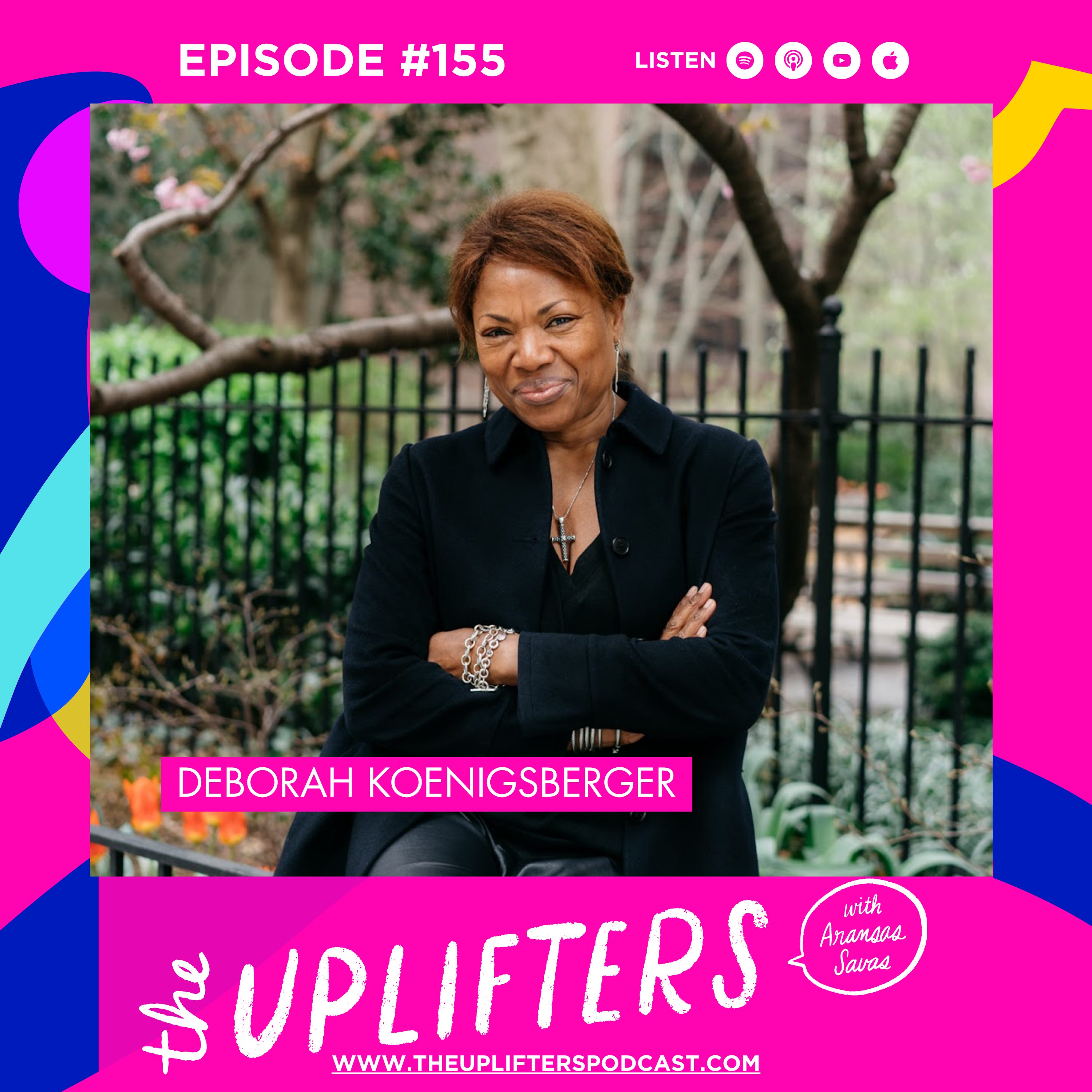
Deborah started her career as a fashion model and stylist. In 1989, she started her own boutique, Noir et Blanc, a French-themed women’s clothing shop in Manhattan.
Then three things happened almost at the same time, like the universe was making a point.
One: She was attending a Stevie Wonder concert, seven nights in a row, third row dead center (of course). His song “Take the Time Out” kept rattling around in her head. What did it mean for her?
Two: Walking her usual route between home and the boutique, she started noticing a young woman sleeping in Madison Square Park. Deborah finally got up the nerve to approach her. The woman was 19. She’d been molested at home, gone to a shelter, been molested there too, and decided the street was safer than any of her options. Deborah, who had grown up surrounded by community, aunts, cousins, always a couch, always a chair, always somewhere safe to land, couldn’t process it. Nineteen years on this earth and not one person had cared enough to protect her.
Third: a makeup artist she’d met on vacation reached out. It was Bobbi Brown, who was just starting to build her name, and she’d been volunteering at a women’s shelter, making the moms feel beautiful. She invited Deborah to do a seminar with her about what to wear when going out. That shelter, it turned out, was between Deborah’s home and her boutique. She had walked past it every single day without knowing it existed. A few months later, she asked the executive director: What do you do for Christmas? They went to the 99-cent store and filled a big bag, and each child got to pick one toy.
Deborah thought: That is not Christmas. So she used that season’s proceeds from Noir et Blanc to sponsor a big Christmas party for all 135 kids and their moms. But it was at that party that she got her real education. A little girl ran to show her mother what she’d gotten, and her mother said flatly, “So what. Ain’t nobody ever done nothing for me”. It gutted Deborah at first. Then she sat with it. The mother wasn’t ungrateful. She just didn’t know what this was. She’d never had it. And if she had never felt cared for, she couldn’t do it for her kids. So the work got bigger. Not just Christmas, but Easter, every holiday, every moment that says: you belong, you are seen, someone thought of you. And eventually Deborah understood: it was the mothers who needed support most of all. If mama ain’t happy, ain’t nobody happy. A magnet from her own mother’s fridge became the philosophy of Hearts of Gold.
Studies consistently show that women over 40 experience a significant shift in motivation, moving away from external validation and toward meaning-making. The challenge isn’t finding the energy for purpose. It’s giving ourselves permission to act before we have the whole plan.
Her Courage Practice: The Knot Principle
Imagine a piece of rope tied into a hundred knots, Deborah says. They look impossible. You don’t even want to start. But once you work that first knot loose and thread the loop through, you can get to the next one. And suddenly you realize you can do the whole thing.
She calls this taking baby steps, but I think it’s something more specific than that. It’s not about shrinking the goal. It’s about refusing to look at the whole rope at once. Today’s problem is this. Let me see if I can help them with this. And then the next thing. And then the next.
For 30 years, Deborah has untied the rope one knot at a time for thousands of families. The audacity of that, when you look at the full picture, is staggering. But she never looked at the full picture. She just worked the knot in front of her. That’s it. That’s the whole practice.
What would you be able to do if you stopped looking at the whole rope?
5 Ways Deborah Shows Us How to Build Our Courage Capital:
Engages instead of averts. Deborah walked toward a young woman sleeping in a park when every instinct says to look away. That single act of engagement started a 30-year movement. The next time you feel the pull to scroll past something hard, consider: what happens if you look up?
Acts on what she has, not what she lacks. She didn’t have a nonprofit infrastructure. She had a fashion boutique, a Christmas spirit, and a credit card. She sponsored Christmas for 135 families with what was already in her hands. What’s already in yours?
Teaches by living, not preaching. Her sons grew up watching their mother do this work, not hearing lectures about it. Her younger son was five years old when he found money on the street and immediately asked if he could give it to the kids in the shelter. Courage is caught, not taught.
Redirects worry into energy. Worrying is energy too, but it’s energy that stays inside and reaches nobody. When she feels overwhelmed by the scale of homelessness, she doesn’t sit with the feeling. She asks: what can I do today? Then she does it.
Asks for what she needs and makes it easy for others to give. Her Road to a Million campaign is a masterclass in accessible generosity. Get ten friends to donate five dollars. Drops of water fill a bucket.
Lift Her Up
Visit heartsofgold.org to make a donation to Hearts of Gold’s Road to a Million campaign (even $5 makes a real difference), sign up to volunteer your time or professional skills, or donate clothing to the TTH Vintage thrift store at 40 West 25th Street in Manhattan. Follow along on Instagram at @heartsofgoldnyc.
And if you’re local to New York, I’m planning a little shopping party at the store. Come thrift with me and support something real. Details coming soon on Substack.
If you loved this story...
This is the final episode in our Women Making History Through Small Acts series, and it joins a constellation of conversations about women who saw a gap and decided to fill it. Start with Terry Grahl’s episode, founder of Enchanted Makeovers, who transformed shelter spaces for women and children escaping domestic violence, then visit Kerry Brodie’s episode, founder of Emma’s Torch, which trains refugees and survivors of human trafficking in the culinary arts.


