


If you’ve ever wondered, “Is it too late for me to...” the answer’s NO and The Uplifters are about to show you why. This space is for purpose-driven women who want to do big, brave things in the second half of their lives. I’m your host, Aransas Savas, and I’ve spent the last 20 years at the intersection of behavior change research and coaching.
In honor of Women’s History Month, we’re featuring midlife women who are making history through small actions.
Corinne van der Borch and Edwina White whose documentary subject, Miss T, a Brooklyn crossing guard teaches us how tiny moments can have deep and lasting impact. Listen HERE.
Rebecca Wells and Carolyn Broullon, who ran against each other for mayor in a tiny New Jersey town. They’ll show us how proximity and face-to-face engagement can reconnect communities - and why your backyard is the place to start making change. Listen HERE
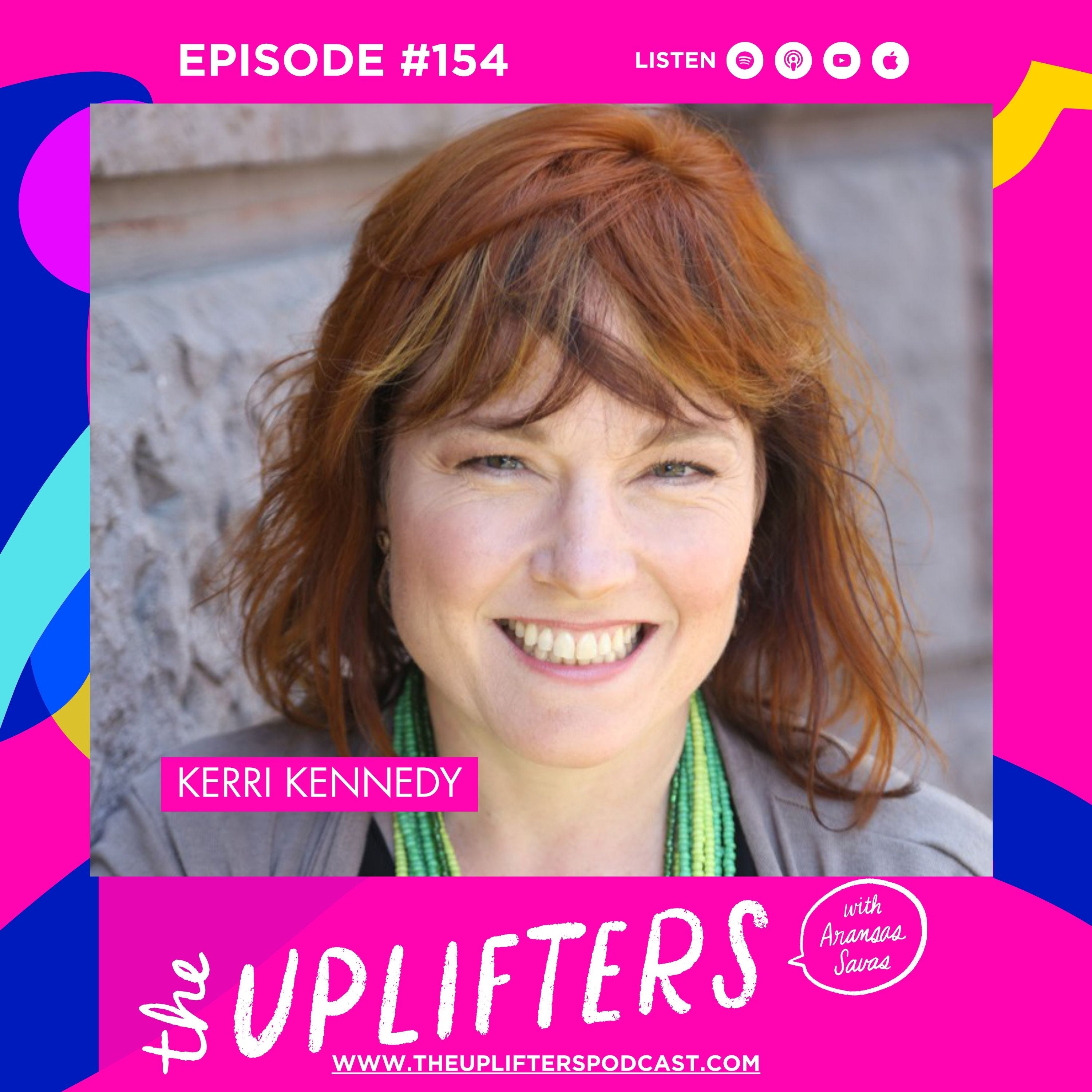
Kerri Kennedy, a global peace leader, who has spent two decades challenging authoritarianism worldwide. She’ll teach us the specific actions ordinary people (especially midlife women) can take right now to protect democracy - no political experience required.
Deborah Koenigsberger, a former model, who started Hearts of Gold, which has helped over 45,000 homeless mothers and children since 1994.
When Ruperto Vicens Marquez, a beloved husband, father of three young children, and the chef and co-owner of a beloved small-town restaurant, was taken by ICE last October, he went quietly. But his community got very, very loud.
Seeing how a vital member of the community who had been in the U.S. for nearly two decades, who had valid, current work papers, could be taken from his home, work, and family brought a national crisis that might have once felt abstract into very clear focus.
What if his neighbors never knew? What if the story only spread in whispers, distorted by whatever voice happened to repeat it?
But that’s not what happened. The townspeople organized. They moved strategically. And ultimately, a few weeks later, Ruperto was released.
This wasn’t a fluke or an accident. It was because there was a leader who enlisted a team of experts to write press releases and activate media contacts to galvanize local, state, and national government. Her name is Kerri Kennedy.
As I sat across from Kerri on this episode, I kept thinking: she is a template. Not because her credentials aren’t extraordinary (they very much are), but because the tools she used are tools any one of us can build.
Kerri is the International Associate General Secretary at the American Friends Service Committee, where she oversees peacebuilding, humanitarian response, and migration programs across four regions and more than 20 country offices. She’s appeared on CNN, Al Jazeera English, and NPR. She co-edited the book Indivisible: Global Leaders on Shared Security. She’s trained women members of Parliament in Afghanistan while moving from safe house to safe house because most of her trainees had death threats issued against them. She founded two PACs in New Jersey to get more women elected. She has talked with Desmond Tutu. And she grew up in a small house in Union, NJ with five brothers, which, she says with a grin, is where she learned to be a peacebuilder.
Kerri doesn’t think of civic engagement as something extraordinary people do. She thinks of it as something ordinary people do together. The science of civil resistance (and yes, there is actual science) shows that we only need 3.5% of a population, acting in a sustained, nonviolent way, to create meaningful change. Not everyone, every day. Just enough of us, enough of the time, doing whatever we can from wherever we are.
Her Courage Practice
Kerri calls it the Porous Choir.
When she’s describing how to sustain any movement over the long haul, years and decades rather than days and weeks, she uses this image: a choir where every individual voice matters, but no single voice has to carry the whole song. When your voice is tired, when you’ve given everything you have and still feel like it’s not enough, you rest. The choir doesn’t collapse. The sound continues. Others hold it while you recover.
It’s one of the most useful frameworks I’ve ever heard for the ongoing work of showing up in the world, whether that’s in a community, a family, or a workplace. We don’t have to be heroes. We don’t have to show up every day at full volume. We just have to be part of the choir, contributing when we can, resting when we must, trusting the collective to carry what we can’t.
What the Research Says
Science tells us that midlife women are uniquely positioned for exactly this kind of civic engagement. By our 50s, our identity certainty is measurably higher than at any other point in our lives (increasing toward a peak around age 65), which means we act more decisively from our values with less second-guessing. Kerri describes this shift vividly: she no longer ponders, she acts. She sees the problem, she mobilizes, and she’s okay with failure if it comes. Research on mirror neurons also shows that we can actively train our brains to expand our sense of “ingroup,” moving from narrow tribal identity toward broader community connection, which is exactly the skill democratic resilience requires.
5 Ways Kerri Kennedy Shows Us How to Build Our Courage Capital:
Acts from identity certainty, not performance. Kerri has always known her values, and she’s spent decades narrowing in on where they intersect with her skills. She doesn’t try to do everything. She shows up where she’s strong and pulls in others for the rest.
Builds the fear threshold incrementally. She’s not fearless. She’s been moving from safe house to safe house with women who had death threats, coordinating humanitarian responses in active conflict zones, and standing up at local town meetings in a politically divided community. Each act of courage builds capacity for the next. She describes it like a muscle: you stretch, you rest, you grow.
Translates paralysis into a menu. When people tell her they don’t know how to help, Kerri doesn’t give them one answer. She gives them ten, calibrated to different levels of risk and resource. Spend with your values. Sign a letter. Call your representative. Show up to a vigil. Go to a Know Your Rights training. Join a mutual aid network. There’s always something that fits where you are right now.
Practices the “opposite” as a default. Watching too much news? Turn it off and go outside. Feeling isolated? Call a neighbor. Feeling overwhelmed by the global? Do something local. The antidote to overwhelm or paralysis is almost always in the opposite direction from where the spiral is pulling you.
Sets medium-term goals for long-term work. She talks about 1% better every day, but she also maps out where she wants to be in one, three, and five years across work, family, health, and joy. She does semi-annual check-ins to see if her time reflects her values. It’s the same goal-setting wisdom that applies to weightlifting applied to the work of building a more just world.
Lift Her Up
Kerri’s work is through the American Friends Service Committee at afsc.org, where you can find volunteer opportunities, nonviolent movement actions, and congressional alerts organized by issue. You can also connect with her on LinkedIn or follow her on Instagram.
If you loved this story...
This episode is part of our Women’s History Month series, and it pairs beautifully with Amy Cohen’s episode, the co-founder of Families for Safe Streets, who turned devastating personal loss into landmark legislation. For more on women leading from the front lines of public life, check out Rev. Ann Kansfield’s episode (FDNY chaplain and author of Be the Brave One) and Laura Kavanagh’s episode, the first woman to serve as NYC Fire Commissioner in the agency’s 157-year history.
Your Turn
How do you take a tiny step forward when you feel overwhelmed? Share it in the comments.


