


If you’ve ever wondered, “Is it too late for me to...” the answer’s NO and The Uplifters is about to show you why. This space is for purpose-driven women who want to do big, brave things in the second half of their lives.
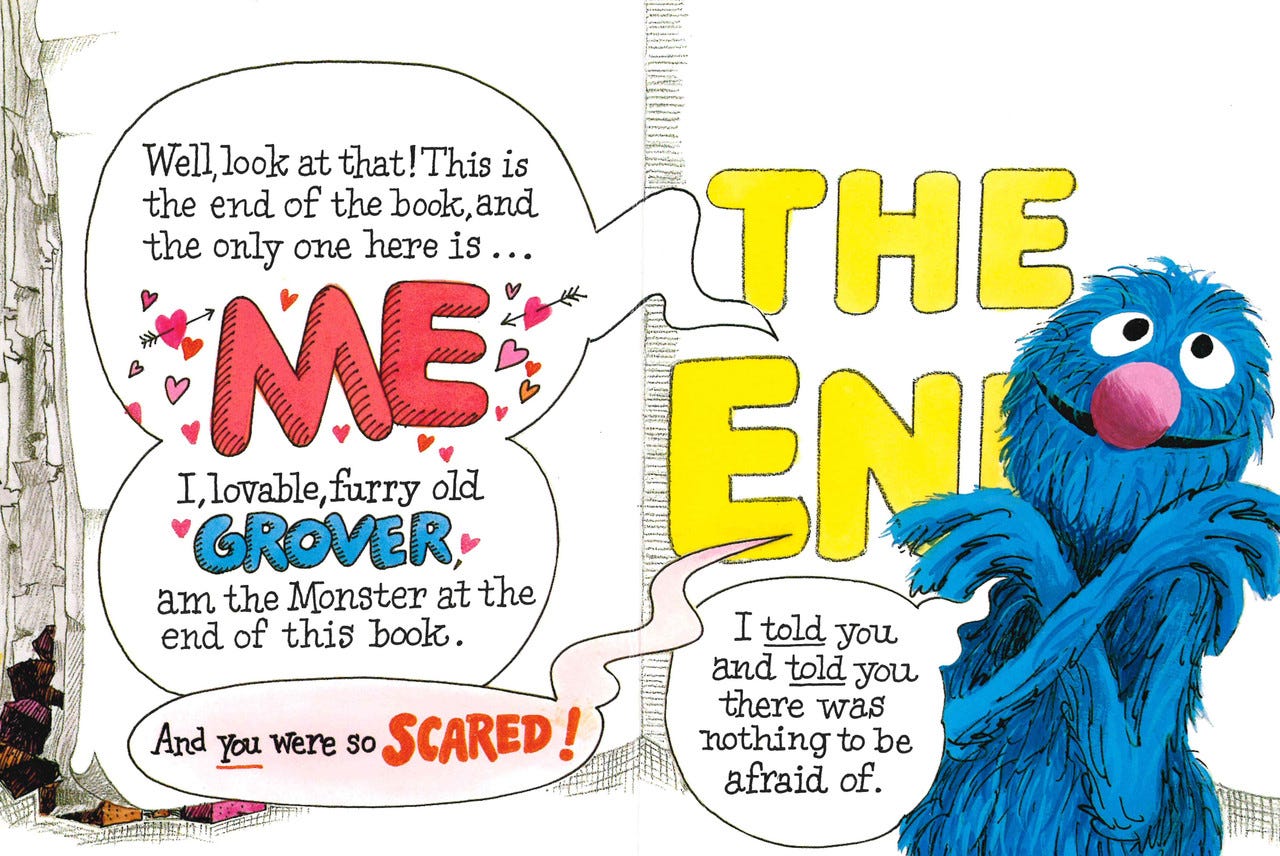
Do you remember The Monster at the End of This Book? Grover spends the whole story desperately trying to keep you from turning the page, because he’s terrified of the monster waiting at the end. And then you get there, and the monster is Grover.
I was Grover this week.
I spent two deep, locked-in writing days with my book, chasing down research, and tightening up narratives. There were moments of flow, and feeling like, “Damn, I was really born to write this book”. And then I started thinking about sending the first section to my editor.
My editor is not some gatekeeping Oz. She’s someone who has shaped books I love, who is passionate about this topic, who genuinely wants this to be the best book it can be. She is exactly the partner I dreamed of for this project.
And I am scared out of my mind to send it to her.
Wednesday morning, I texted Kara Cutruzzula : OK, having an existential crisis right this very second. The one that sounds like: this entire thing is totally shit, and no one should ever see it. All triggered by the idea of someone reading my work and having opinions on it. Which is exactly what I want. I cannot write this book alone. I do not want to write this book alone. And yet.
Meanwhile, one of my clients, a CEO, got unsolicited feedback from an industry insider that landed like a finger pointing straight at the heart of everything she’d built. Another, a first-time agency founder after decades as an executive in other people’s companies, hit a rough patch with a client relationship and spent a few minutes in the full spiral: what if it’s all wrong, what if I made all the wrong choices, what if I’m the problem?
We were all, in the same week, crumpling under the weight of being seen.
Here’s what I think is actually happening, for us and for so many midlife women building things for the first time that are truly, unapologetically theirs. Research on how girls are raised shows we’re more likely than boys to be praised for our attributes, for who we are, for being good, being kind, being easy. Not for what we do or build or attempt. The consequence, as psychologist Carol Dweck’s work makes clear, is that feedback on our work gets processed as feedback on our worth. We weren’t trained to separate the two.
So in midlife, when we finally stop building other people’s dreams and start building our own, the feedback stakes feel existential in a way they didn’t before (well, not quite as much). The antidote, it turns out, isn't toughening up or caring less. It's wanting something different from feedback entirely.
I asked Rebecca Bloom, author of When Women Get Sick, what it was like to hear feedback on the impact of her work. She said, “It’s a moral rush, not an empty-calorie candy rush, but a moral rush, because it makes me feel like I’m doing what I’m supposed to be doing. You wake up every morning asking, ‘Am I on the right path? Am I using my gifts? Am I moving the needle?’ And when someone tells you yes, that’s your answer.”
The women I’ve interviewed who have had unprecedented impact, women like M’Lis Ward and Kathrine Switzer, who did things nobody like them had ever done, they weren’t asking what does everyone think of my performance? They were asking how do I do this as well as it can possibly be done?
One orientation is about protection. The other is about impact. I want impact.
The monster at the end of the book is me. But so is the courage to turn the damn page anyway. I’m printing the manuscript this weekend. Reading it on paper. And then I’m sending it.
What are you sending this week, even a little scared?
P.S. If you’re in New York, I’d love to hang out with you on May 28 while shopping and sipping sangria, all in support of the wonderful nonprofit Hearts of Gold. All the details HERE.
P.P.S. I’m currently offering my workshop, “Carrying Invisible Loads,” to organizations and ERGs during Mental Health Awareness Month and beyond. If your team is in that “everyone is at a breaking point” season, this is for you. Reply to this email to learn more.
P.P.P.S. Paid subscribers, I’ll see you later this week with a series of reflection prompts and an invite to our weekly Uplifters co-working Zoom/unhinged dance party.
“The consequence, as psychologist Carol Dweck’s work makes clear, is that feedback on our work gets processed as feedback on our worth. We weren’t trained to separate the two.”
That part!! Feedback to me on anything is processed as feedback on my worth. I take it in but don’t let it stay in then process as it as feedback on the work. Nothing more nothing less. Thankfully, I no longer stay in that first step of processing.
I submitted my book to be featured in an online and print magazine and it was selected as one of the books of the month. https://heyzine.com/flip-book/3babcb1d5c.html#page/1