


If you’ve ever wondered, “Is it too late for me to...” the answer’s NO and The Uplifters is about to show you why. This space is for purpose-driven women who want to do big, brave things in the second half of their lives.
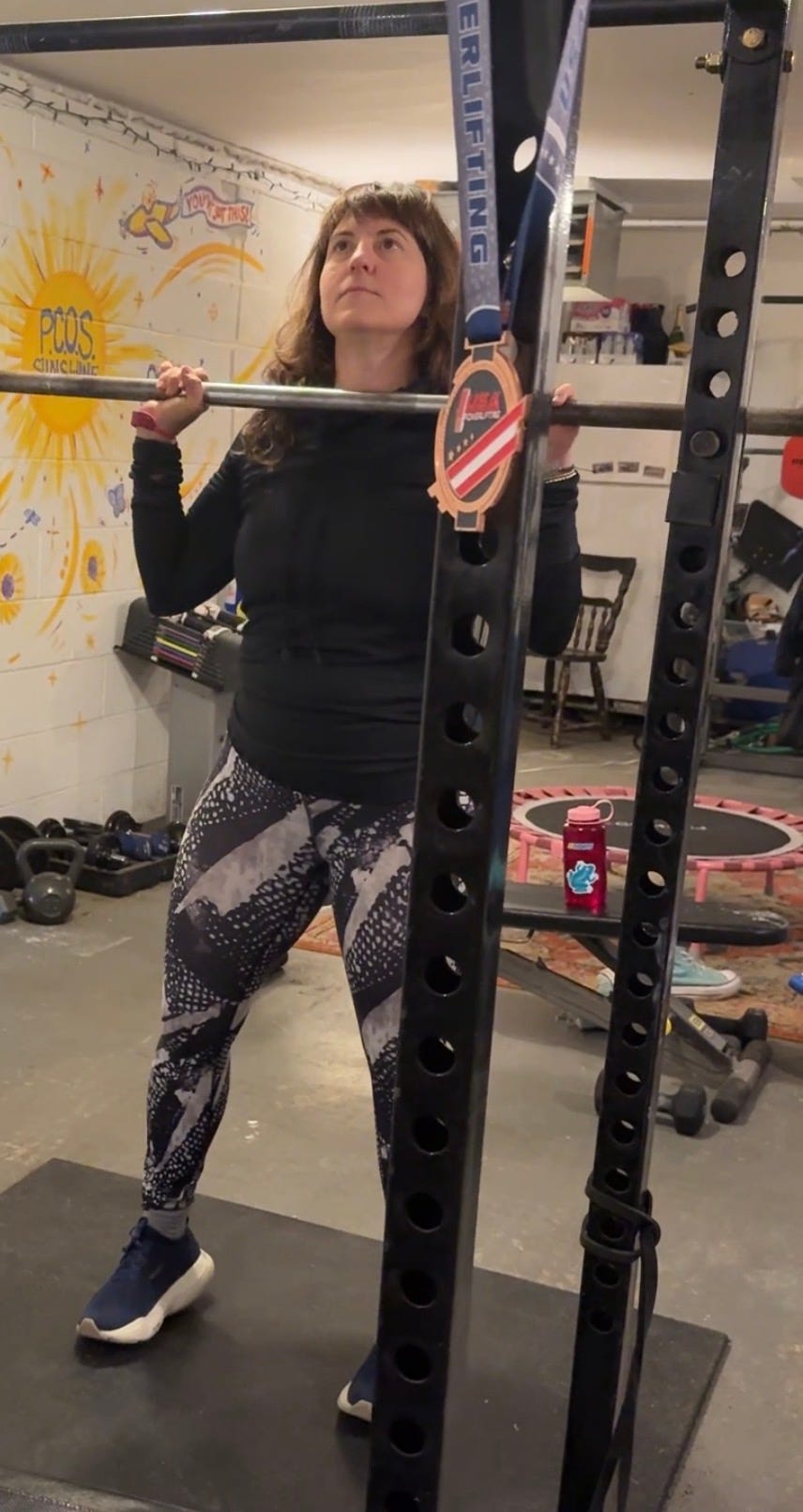
I’ve been feeling weirdly ambivalent about my workouts lately.
Which is strange because I’ve been lifting weights casually for years. I show up. I do the reps. I like seeing my shoulders take shape and increasing the weight or reps a little each week. And intellectually, I know the super long-term benefits matter: lifting heavy in midlife builds bone density, improves balance, maintains muscle mass as we age, protects against osteoporosis, and keeps us functionally strong well into our 80s and 90s. And I’m practicing being the 90 year old I want to be, so it really does matter to me
And yet... I haven’t been energized by it.
Like most people, when I’m ambivalent about something, it’s usually because my goal isn’t actually compelling. Not because the thing isn’t valuable, but because I’m missing the piece that makes my brain care.
The Missing Medium-Term Goal
The long-term stuff is great. I want to be strong and balanced in my 80s. But that’s so far away that my brain treats it like abstract insurance, not like something I’m actively building toward.
The short-term stuff is fine. I can track my reps each week. I can notice when my shirts fit differently. But those micro-wins weren’t adding up to anything that felt like an achievement.
What I was missing? A medium-term goal. Something I could envision myself reaching. Something I could name and check off as an outcome. Something I could see results on before my 80th birthday.
So I talked to my trainer about it.
“What should I be working toward?” I asked. “What’s the thing that would show me I’m actually making progress?”
She thought for a second. “For your shoulder press—that’s your weakest exercise—let’s aim for you to lift ‘a plate.’”
“A plate?”
“A 45-pound barbell plus two 25-pound plates. That’s the goal. Lifting a plate.”
I don’t know if she made this lingo up just to pacify me, but I loved that it had a name. It was a thing. A real benchmark. I could picture it and measure it.
And suddenly, I cared again. I was gonna lift a plate.
As a former runner who used to chase race goals constantly, this felt like having something to shoot for again. Something that made my weekly efforts add up to something concrete.
Why Our Brains Need Goals (But Not Just Any Goals)
Research in motivation science shows that goals work best when they hit a specific sweet spot. They need to be:
Concrete enough to visualize. “Get stronger” is too vague. “Lift a plate” is something I can picture.
Challenging but achievable. If my trainer had said “bench press 200 pounds,” I would have laughed and given up. “Lift a plate” feels hard but possible.
Meaningful in multiple ways. The long-term health benefits matter, and the incremental goals are fun, but the medium-term achievement of hitting a specific milestone is what keeps us showing up week after week.
Connected to identity. I miss being “a runner.” Now I get to become “someone who can lift a plate.” That identity shift matters.
Psychologist Dr. Edwin Locke’s research on goal-setting theory shows that specific, challenging goals lead to higher performance than vague or easy goals—but only if we’re committed to them. And commitment comes from goals that feel both meaningful and achievable.
The long-term “I want to be healthy when I’m old” goals are important, but they’re terrible at motivating daily action. They’re too far away, too abstract, too easy to put off until tomorrow.
The medium-term goals—the ones you can achieve in 3-12 months—are the sweet spot. Close enough to feel real, far enough to require sustained effort.
I’m working with a woman right now who left her corporate career to go all-in on her creative work. Like so many of my midlife clients, she has the long-term vision: build a sustainable creative practice that supports her life and makes meaningful impact.
Beautiful. Important. And completely overwhelming on a Tuesday morning when she sits down to work.
What was missing? The medium-term milestone that would tell her she’s on the right path.
We landed on: “Publish 12 essays that I’m genuinely proud of by the end of the year.”
Not “become a successful writer” (too vague, too far away). Not “write every day” (that’s a practice, not a goal). But “12 essays I’m proud of” (concrete, measurable, achievable, meaningful).
Now when she’s ambivalent about sitting down to write, she can ask herself: “Does this get me closer to my 12 essays?” If yes, she writes. If no, she does something else.
The goal is doing its job.
What About Your 75 Soft Goals?
If you’ve been carrying on with your 75 Soft practices from a few months ago, how’s it going?
Have you gotten a case of “I don’t care”?
If so, it might not be about willpower or discipline. It might be that your goal isn’t compelling enough.
Ask yourself:
What’s the medium-term milestone? Not “be healthier” or “feel better,” but what specific thing would you be able to do, achieve, or show that would tell you this practice is working?
Does it have a name? “Lift a plate.” “Run a 5K.” “Write 12 essays.” “Apply for 3 grants.” “Lead a presentation without notes.” Names make goals real.
Can you visualize it? Can you see yourself doing the thing? If it’s too abstract or far away, your brain won’t treat it as real.
Does it connect to who you’re becoming? Is this goal about an identity you want to step into, not just a behavior you think you should do?
Your Turn
What goal have you been feeling ambivalent about?
Try this:
What’s the long-term benefit? (Why it matters in the big picture)
What’s the medium-term milestone? (What you could achieve in 3-12 months that would show it’s working)
What’s the name for that milestone? (Make it concrete and specific)
Who do you become when you achieve it? (What identity are you stepping into?)
Drop your answers in the comments. Or just try it privately and see if naming the milestone brings back the energy.
I’m betting that once you have a plate to lift (literally or metaphorically), you’ll care a lot more about showing up.
See you Friday!
Aransas
P.S. In Strategy Sessions, we create your three-year strategy and do this work for your entire year—identifying the medium-term milestones that make your big vision feel achievable and your daily practices feel meaningful. Reply to this email if you want help with this.
P.P.S. Uplifters Live is March 13! One month away. Come spend the day with women who have clear, compelling goals and the courage to chase them.
Always great food for thought. Been chasing my goal weight (trying to get back to it) for a couple of years now. I get close then zap, it's gone. Haven't been able to figure out why it's been so elusive. I need to try this "medium term milestone".