


If you’ve ever wondered, “Is it too late for me to...” the answer’s NO and The Uplifters is about to show you why. This space is for purpose-driven women who want to do big, brave things in the second half of their lives.
There’s someone whose opinion of me right now isn’t very high. Someone who mattered to me a lot in my life. So it feels really hard to not be liked or included by this person right now.
For weeks, this has been taking up way too much space in my brain. Every time I sit down to work on my book or do something that actually matters, there’s this nagging voice: “But what will THEY think on the other end of the internet?”
Which is absurd. This person isn’t even an active part of my life right now. And yet, their imagined judgment stops me from moving forward with what matters to me right now.
So I used the tool I have used with almost every client I’ve coached through a similar block.
I call it “What’s Truer Than True” (which I sing in my head to the tune of “What’s cooler than cool? Ice cold” from this Outkast song).
Here’s how it works:
On the left side of your page, write down the worry. In the middle, write what’s true. On the right side, write what’s MUCH truer.
My Example:
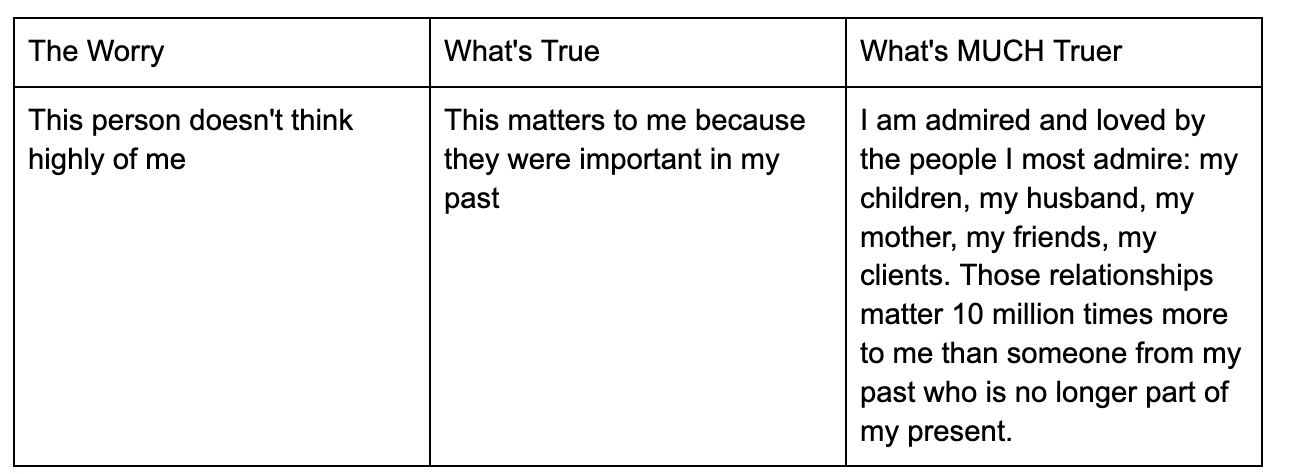
Seeing it all laid out this way brings me back to the present version of myself. Not completely—I’m human. But enough that I can get back to work. Enough that their imagined judgment stops running the show. And every time I do it, the weight gets a little lighter.
Why This Works
Our brains are terrible at absolute judgments but excellent at relative comparisons. When you’re stuck in worry about one person’s opinion, your brain treats it as THE ONLY data point. But when you create a comparison—”this person vs. all these other people who matter to me”—your brain can suddenly process it more accurately. This is why the third column (what’s MUCH truer) is so powerful. It’s not just positive thinking; it’s giving your brain the comparative data it needs to make an accurate assessment of importance. Psychologists call this “proportionality thinking,” and it’s one of the fastest ways to shift from rumination to clarity.
By midlife, we’ve accumulated a whole host of voices in our heads. Some helpful, some super not helpful. Almost every person I’ve ever coached has had a moment where we’ve unlocked a huge limiting belief by naming whose judgment they’re afraid of.
When we actually NAME the person—not just “people will think” or “society says” but THIS SPECIFIC PERSON whose opinion I’m afraid of—we usually discover one of two things:
They don’t matter at all. They’re someone from our past, or someone we barely know, or someone whose values are completely misaligned with ours anyway.
They matter, but not nearly as much as the people who would cheer us on. When we list out the people who actually DO support us, believe in us, and want us to succeed, the math changes completely.
The fear loses its power when we make it specific and then compare it to what’s actually, genuinely true.
Bonus! Building this brain muscle (aka neural pathway) helps us carry lots of other mental loads too.
This isn’t just about other people’s opinions. This technique works anytime I’m worrying about things tied to old programming:
The part of me that wants to be liked by everyone:
Worry: People won’t like me if I’m too bold/opinionated/visible
True: Some people will think I’m too much
MUCH truer: The people I actually want in my life are drawn to authenticity, not performance
The part of me who believes I need to be productive all the time:
Worry: If I rest, I’m wasting time/being lazy/falling behind
True: I grew up believing my worth was tied to achievement
MUCH truer: Rest is what makes sustained creativity and impact possible. I find my best and biggest ideas when I’m not working.
The part of me who believes I don’t get to make mistakes:
Worry: If I mess this up, people will think I’m not trustworthy
True: Perfectionism has protected me from criticism in the past
MUCH truer: Every woman I’ve interviewed for this podcast has made spectacular mistakes. Only people who don’t do things don’t make mistakes, and that feels like a way bigger mistake than any typo.
Your Turn
What worry is taking up too much space in your brain right now? What fear is stopping you from doing the brave thing?
Try the three columns:
The Worry: Write it out. Be specific. If it’s about someone’s opinion, NAME them.
What’s True: Acknowledge why this worry exists. Where did it come from? What programming is underneath it?
What’s MUCH Truer: List the evidence that contradicts the worry. Who DO you matter to? What IS actually true about your worth/capability/readiness?
Drop your ahas in the comments if you want. Or just try it privately and see what shifts.
Aransas
P.S. This is exactly the kind of work we do in coaching—identifying the invisible beliefs that are running the show and replacing them with what’s actually true. Reply to this email if you want help with this.
P.P.S. Uplifters Live is March 13! Come spend the day with friendly, passionate, creative, and deeply generous midlife women who are lifting each other as they rise.
So true! Love this!