



Hi! New here? I've spent the last 20 years at the intersection of behavior change research and coaching. On The Uplifters Podcast, we share diverse stories of trailblazing, change-making women who are doing big, brave things in the second half of their lives, and showing us how we can too!
Listen to This If...
You’re caught between cultures, never quite “inside” or “outside” anywhere
You’re wrestling with what it means to have privilege while people who share your identity are suffering
You want to understand how to build emotional capacity for holding multiple truths at once
You’re curious about what Palestinians are experiencing and thinking right now
This Week’s Featured Uplifter: Hala Alyan
Hala writes about atrocities and the dreams deferred from love-torn relationships as a mother, author, curator, anthropologist, and psychologist. She’s a cultural worker who remains a beacon of resilience to us all. I love how she does not muss or fuss over genre, which is to say her stories belong everywhere.
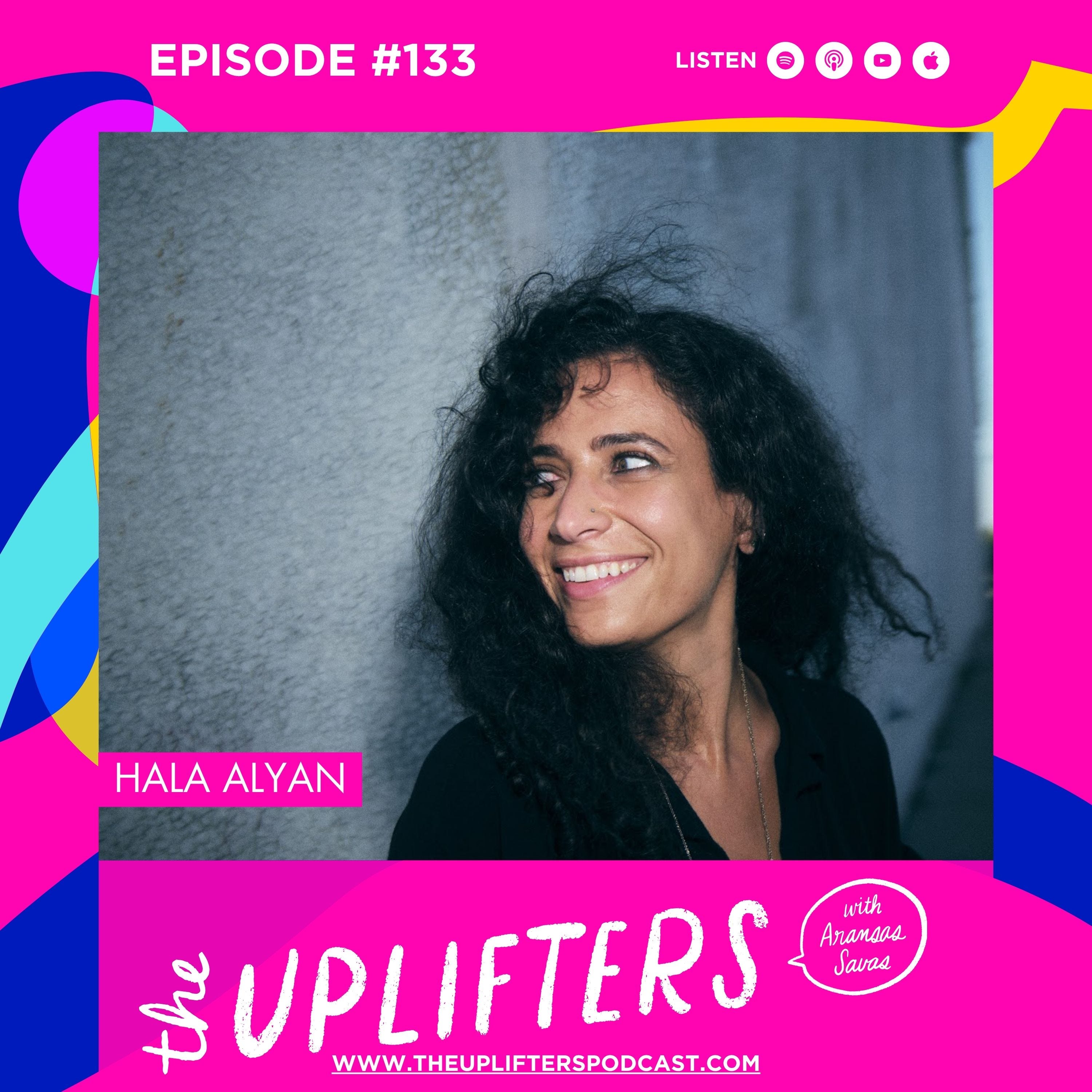
Today I’m talking to Hala Alyan, a Palestinian American poet, writer, professor, and clinical psychologist based in Brooklyn.
Aransas: You wear a lot of hats. A poet, a novelist, a memoirist, a clinical psychologist, a mom, with a Palestinian American identity and a specifically Brooklynite identity. You’ve lived in so many different places. You’ve spoken so many different languages, had so many different experiences. So if you were to introduce yourself, how would you do that?
Hala: There’s actually an exercise that I’ll sometimes give in the cross-cultural therapy class that I teach. You write the five identifiers that you most strongly connect to at this moment in your life. And that’s like really crucial because that highlights positionality and how what’s essential for us changes over time.
And then you cross out one of them, and then you’re left with the top four. And then you cross out another one, and then you are left with three. Then you cross out another one, and you’re left with one. And usually it’s the three-to-two and two-to-one that are the hardest.
And so as you were saying that, that’s what I was thinking of because in this moment, my role and capacity as a mother and as a Palestinian feel really central. And that has obviously everything to do with the circumstances. The roles of writer and professor, and teacher and community member feel kind of like they’ve been consistent in where they are in my life. But Gaza and gelling into what it means to be a mother have not felt separate from Palestine for me. And so that’s been really interesting, to mother while watching and witnessing and trying to understand how, as a member of a diaspora with all these privileges, what can I do? How can I be of service?
Her Courage Practice: Writing to Walk Herself Home
Most writers wait. They give their nervous systems time to process trauma before attempting to transform it into art. They teach from their scars, not their wounds. But Hala didn’t have that luxury with her memoir. She’d sold it on a partial, the deadline was looming, and what was happening in her life—preparing for her daughter’s birth, navigating a crumbling marriage, reckoning with what it means to be Palestinian in this moment—was simply too compelling not to write toward.
So she wrote to walk herself through it. Not writing in hindsight to process what had happened, but writing as a way of moving through what was actively unfolding. It became a form of emotional nesting, she tells me. Taking stock of what she wanted to keep and what she wanted to discard. Excavating her family history. Deciding what stories to pass down to her daughter and which inheritances to leave behind.
The practice itself is deceptively simple: show up to the page when you’re in the thick of it. Write toward clarity you don’t yet have. Trust that the narrative will reveal itself if you’re brave enough to stay with the discomfort. What makes it extraordinary is the courage it requires—to be vulnerable on the page while you’re still vulnerable in life, to craft coherent meaning from experiences that haven’t yet resolved, to offer your uncertainty as a gift rather than waiting until you have all the answers.
This practice ripples outward in unexpected ways. It’s given her clarity about relationships that needed to end. It prepared her for October 7th without her even realizing it (those years of diving into family history and diasporic identity became an accidental training ground for the grief that would follow). And perhaps most importantly, it’s modeling for her daughter what it looks like to be someone who thinks deeply about their life while they’re living it—who doesn’t wait for perfect conditions but instead engages with what is.
Ways She Shows Us How to Build Our Courage Capital:
Get cozy in the not-knowing. Hala’s learned that uncertainty isn’t permanent, even when it feels like it’ll last forever. Nothing stays exactly as it is—eventually something will shift, either because you actively make a change or because life delivers a forcing function (a job offer, a breakup, an invitation, an eviction). The key isn’t frantically searching for answers but rather learning to settle into discomfort with curiosity. This doesn’t mean passively waiting, but rather actively engaging with the uncertainty itself, paying attention to the small breadcrumbs that appear, having the kinds of conversations that might shift something.
Mine your history for evidence, not answers. Here’s why middle age can be such a powerful time for courage: we’ve accumulated data. When something painful happens at 39, we understand that it won’t last forever. We think “This fucking sucks and I’m probably going to lose two years to this bullshit”—which, while not exactly cheerful, is fundamentally different from believing the pain is eternal. Hala points to research showing that suicide risk decreases in middle age for many people precisely because they finally have evidence that difficult things end. Your heartbreak at 16 feels like the rest of eternity; your heartbreak at 40 comes with proof that you’ve survived before and will again. So maybe we can start collecting our own evidence: every challenge we’ve faced and moved through, every uncertainty that eventually resolved, every moment we thought we couldn’t survive but did.
Privilege requires accountability, not guilt. One of the most powerful threads in this conversation is how Hala thinks about her privilege as a member of the Palestinian diaspora with access, safety, and freedom of movement, while Palestinians in Gaza face genocide. She doesn’t get stuck in guilt or shame (which are ultimately self-centered and paralyzing). Instead, she keeps asking: How can I be of service? How do I show up? What does this moment call for from me? The goal isn’t to feel guilt about privilege; it’s to take accountability for what we do with it.
Lift Her Up:
Support Hala’s Work:
Buy or borrow I’ll Tell You When I’m Home from your local bookstore or library
Attend KAN YAMA KAN if you’re in NYC—it’s a beautiful reading series that combines poetry, fiction, memoir, and music while raising funds for monthly mutual aid causes. You can learn more about it by following Hala’s IG.
Share her work with book clubs, writing groups, or friends who appreciate literature that grapples with identity, displacement, and belonging
Support Palestine:
Hala emphasizes that witnessing and being moved by what you see is transformative—educate yourself about what’s happening in Palestine
Support mutual aid organizations working on the ground
The Uplifter Thread
Did you know that every woman on the Uplifters podcast is nominated by a former guest or audience member? This means you and I get to chat with the most inspiring women -- the ones who inspire the women who inspire us!
Our current thread:
Susan Jaramillo→Kate Tellers from The Moth→Cleyvis Natera→ Deesha Philyaw → Mo Browne – Djeli Said → Hala Alyan → who nominates Sahar Delijani as her Uplifter - and describes her as, “A remarkable human and artist, a beautiful writer, a fearless advocate for Iranian human rights.”
Listen to my full conversation with Hala on The Uplifters Podcast.
Uplift With Us!
🌟 Wear your inspiration with an Uplifter necklace. Treat yourself or gift one HERE.
💡 Need clarity on your next chapter? Explore private coaching to illuminate your path HERE.
🚀 Is your team ready to soar? Discover how we can boost your high performers HERE.
